

This article shares personal experiences and is for informational purposes only. It is not career or medical advice.
- Manpower costs are the same in public and private healthcare — the big difference is government subsidies that keep public bills lower.
- Private care offers faster access and more comfort, but costs more due to rising rents and wages post-COVID.
- Healthier SG helps subsidise chronic drugs in private GP clinics, but margins remain tight for doctors.
- You can’t have good, fast, and cheap — public is affordable but slower; private is quicker but pricier. Choose based on urgency, budget, and trust in a specific doctor.
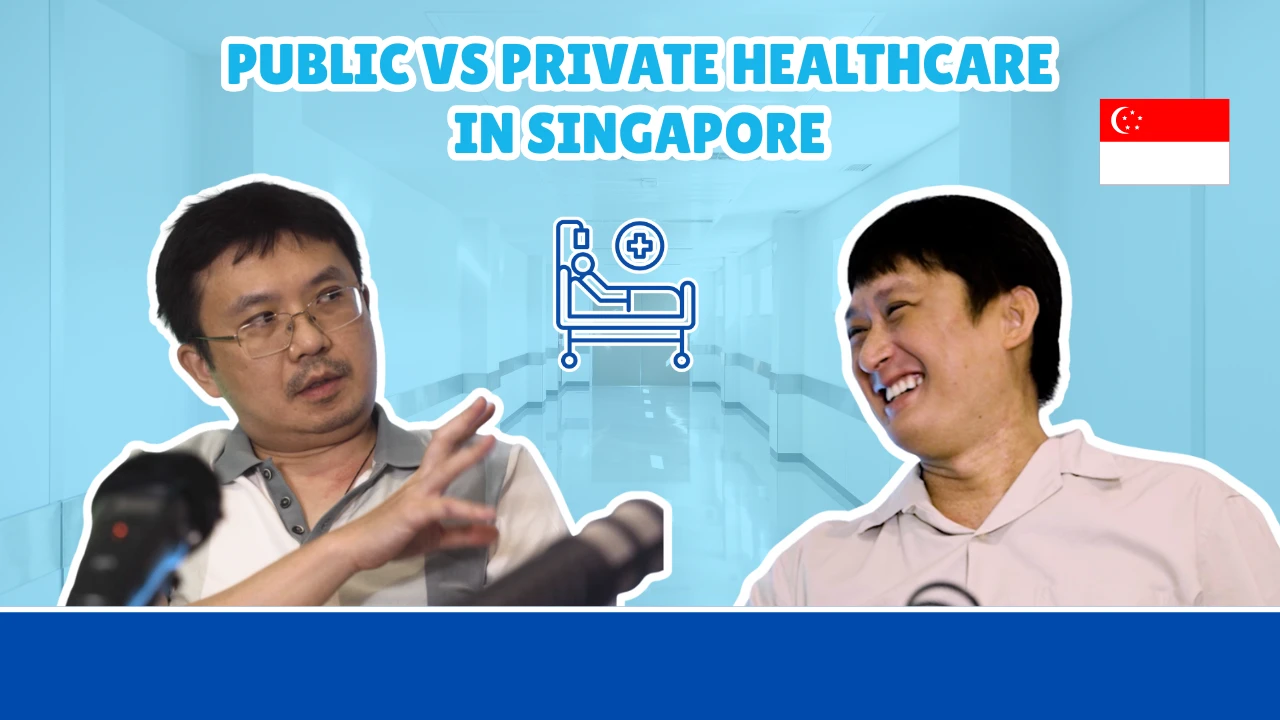
In an intimate, no-nonsense conversation on the second episode of Uncle Talks Podcast, three seasoned Singapore doctors— Dr Kenneth Tan (a private GP), Dr John Hsiang (a private gastroenterologist), and Dr Leong (a veteran family physician) sat down to answer the question patients whisper in clinics every day: “Doctor, should I go public or private?”
What followed was a refreshingly honest dissection of costs, quality, speed, and the hidden pressures shaping healthcare in Singapore today.
The One Cost That Doesn’t Care About Subsidies
“Manpower cost is really the same in both public and private,” Kenneth, a private GP running his own clinic in the heartlands, began. Doctors can choose where they work, so whether they end up in a restructured hospital or a private practice, their salaries—and therefore the underlying cost of care—move in lockstep. The only reason public bills sometimes appear smaller, he explained, is the heavy layer of government subsidies that private clinics simply do not enjoy to the same degree.
John, a gastroenterologist who operates in both Farrer Park and Mount Elizabeth hospitals, nodded in agreement.
After COVID, rental costs in medical suites have been climbing at an astonishing rate—sometimes 10 per cent per annum—and nursing salaries in the public sector jumped again recently by around seven per cent.
Private clinics and hospitals have no choice but to match those rises or lose staff. The result? A quiet but relentless squeeze that patients feel every time they open their wallets.
Healthier SG: A Bold Attempt to Keep Private Care Affordable
The government is not blind to this pressure. Through the Healthier SG initiative, private GPs can now order subsidised chronic medications from a central purchaser (Alps) and cap the price they charge patients—bringing it in line with polyclinic rates.
For patients on multiple medicines, the savings can be significant. Yet the doctors were candid: the margin for clinics remains razor-thin, and the promised Chronic Enrolment Grant often feels like a drop in the ocean compared with rising rents and wages.
As one of them put it, “We’re pure commercial. Every single cent we have to earn it.” Unlike polyclinics or charity-supported clinics, private GPs carry the full weight of rental, staff, and inflation without the safety net of institutional funding. The conversation revealed a truth many patients never see: keeping private primary care accessible is a daily high-wire act.
Ward Classes, Premier Suites, and the Illusion of Luxury
When the discussion turned to hospital stays, the differences became starker. In the public system, patients can still choose between heavily subsidised C-class or B2 wards and the more comfortable (but still subsidised) B1 or A wards.
Private hospitals, on the other hand, generally offer only single-bedded or four-bedded rooms—unless, as John joked, you fancy the Marina Bay Sands-style presidential suite at ten thousand dollars a night.
Quality of care, however, is remarkably consistent. “You get the same nursing staff,” John emphasised, “maybe just a bit more attention to detail in the VIP areas.”
The real divergence lies in speed and convenience: private hospitals can often arrange a CT scan or endoscopy within days, while public wait times can stretch to weeks or even months.
For many working Singaporeans, time is the ultimate luxury.
The Triad That Cannot Be Broken: Good, Fast, Cheap
The doctors distilled the entire public-private debate into a simple, brutal truth borrowed from business: you cannot have something that is good, fast, and cheap at the same time.
In private healthcare, you can usually have good and fast—but it will never be cheap.
In the public system, you can have good and relatively affordable—but rarely fast.
Patients who demand all three, Kenneth noted with a laugh, are effectively asking for fine dining at McDonald’s prices. The analogy stuck with the listeners because it is painfully accurate.
Whether it is a colonoscopy that cannot wait three months or an MRI for persistent headaches, the moment urgency enters the equation, many Singaporeans find themselves crossing the divide into private care—insurance or not.
Choosing Your Specialist: Trust Over Brand
Perhaps the most valuable advice came when the doctors revealed how they themselves guide patients.
Kenneth admitted he refers to specialists he has known for years—classmates, colleagues from the GP cooperative—people whose charges he trusts and whose work he respects. John echoed the sentiment: when insurance panels dictate the doctor, patients sometimes miss out on the single most important factor—personal trust.
Even in the public system, they urged patients to try for a named consultant if the condition warrants it. Being seen by the senior specialist rather than a rotating registrar can make a world of difference in continuity and decision-making. And for truly urgent cases, the doctors hinted that a quiet word from a trusted GP can occasionally move mountains in public waiting lists—though they were quick to add that such favours are reserved for genuine need.
The Bottom Line for Patients in 2026
By the end of the conversation, the message was clear: neither system is inherently “better.” Public healthcare remains extraordinary value for money, backed by MediFund for the truly needy and world-class doctors. Private healthcare offers speed, convenience, and often a more personalised experience—at a price that continues to climb.
What matters most, the doctors agreed, is alignment between your priorities and your wallet. If cost is the primary concern and you can wait, the subsidised public route is still one of the best deals on earth. If time, comfort, or a specific trusted doctor is what you value, private care delivers—provided you go in with eyes wide open.
As one of them summed up: “At the end of the day, we’re all doctors. We all try to help our patients. The system might be different, but the heart is the same.”
In a city where healthcare costs are rising faster than most salaries, that shared heart—and the candid advice from doctors who live these choices every day—might just be the most reassuring news of all.
Want to hear more about resilience, timing, and the real-life moments that shape a medical career? Listen to the original Uncle Talks Podcast.
PUBLIC VS PRIVATE HEALTHCARE
Frequently Asked Questions
What is the main cost difference between public and private healthcare in Singapore?
Manpower costs (doctors, nurses) are essentially the same in both sectors because professionals can work in either. The key difference is government subsidies — public hospitals receive substantial ones that reduce patient bills significantly, while private facilities get far less support, so costs are passed on to patients.
Why do private healthcare costs feel higher after COVID?
Rental costs for medical suites have risen sharply (often 10% per year), and public-sector nurse salaries increased (e.g., around 7% recently), forcing private clinics and hospitals to match wages to retain staff. Without equivalent subsidies, private providers must cover these rises through higher fees.
How does Healthier SG help with private healthcare costs?
Healthier SG allows enrolled private GPs to order subsidised chronic medications from a central purchaser (Alps) and cap prices at polyclinic levels. This helps patients on multiple medicines save money, but clinic margins remain slim, and the scheme doesn’t fully offset rising rents or wages.
Is the quality of care better in private hospitals than public ones?
Quality is generally comparable — you get the same skilled doctors and nurses in both. Private hospitals may offer more personalised attention (e.g., in premium suites) and faster access to scans/procedures, but the core medical care and outcomes are high in both systems.
How do ward classes work in public vs private hospitals?
Public hospitals offer tiered wards (C, B2, B1, A) with increasing comfort and decreasing subsidies. Private hospitals typically provide single or four-bedded rooms (or luxury presidential suites at high cost), with little variation in basic room quality.
Should I choose public or private for specialist care in Singapore?
It depends on your needs: public is more affordable with subsidies (and Medifund for the needy), but waits can be longer. Private offers quicker appointments and trusted specialists (often via GP referrals or insurance panels). Many doctors recommend trying for a named consultant in public for continuity if possible.
Can I get the best of both worlds?
Not fully — you can’t have good quality, fast access, and low cost simultaneously. Public tends to be affordable but slower; private is faster and more comfortable but more expensive. Align your choice with urgency, budget, and whether you have insurance or subsidies.
Medically Reviewed
About the Experts
 Doctor
Dr Leong Choon Kit
MBBS, M.Med (Public Health), GDFM, MCFP(S), FCFP(S), FAMS (Family Medicine) — Adjunct Assistant Professor, Duke-NUS & NUS
Dr Leong Choon Kit is a family physician and public health advocate with extensive experience in primary care, public policy, and vaccination initiatives. He leads Tampines Family Medicine Clinic and the Class Primary Care Network, and co-authored Singapore's Adult Vaccination Guidelines. An Adjunct Assistant Professor at both Duke-NUS Medical School and NUS, he has spent over a decade mentoring pre-medical students across all three local medical schools and is deeply committed to nurturing the next generation of doctors.
 Doctor
Dr Kenneth Tan
MBBS (S'pore), Grad. Dip. Family Medicine, Grad. Dip. Sports Medicine, M.Med (Fam Med), MCFP(S), PG Dip. Clinical Dermatology (UK)
Dr Kenneth Tan is a family physician with a diverse background spanning medical education, dermatology, and sports medicine. He serves as a Council Member of the College of Family Physicians Singapore, Associate Programme Director for the Graduate Diploma in Family Medicine, and Associate Lecturer at NUS. A Sub Lead for the Class Primary Care Network and NUS medical school assessor, he brings first-hand experience of the undergraduate selection process to his practice and mentorship work.
 Specialist
Dr John Hsiang
MBChB (NZ), FRACP (Australasia), MD (Doctorate), FRCP (Edinburgh), FAMS (Gastroenterology) — Adjunct Associate Professor, NUS & Duke-NUS
Dr John Hsiang is a gastroenterologist at Mount Elizabeth Hospital with over 15 years of experience in gastrointestinal diseases, fatty liver disease, and viral hepatitis. A graduate of Otago Medical School, he completed post-specialist hepatology research at the Chinese University of Hong Kong, earning a doctorate focused on chronic liver disease. An Adjunct Associate Professor at NUS and Duke-NUS, he has over 25 peer-reviewed publications and brings an international perspective to both clinical practice and medical education.
Written By
About the Writer
 Writer
Timothy Leong
Writer, Content Editor & Marketing Specialist — MMC
Timothy Leong is the writer, content editor, and marketing specialist at MMC. With experience in writing and creating websites for local businesses, he makes sure that everything online runs smoothly.