
Disclaimer: This is general nutritional information and not medical advice. Protein shakes are supplements, not medicine. Consult your doctor before adding to your diet, especially if you have health conditions.
Affiliate Disclaimer:We bought these products ourselves. This article contains no affiliate links and MMC earns nothing from any purchase you make.
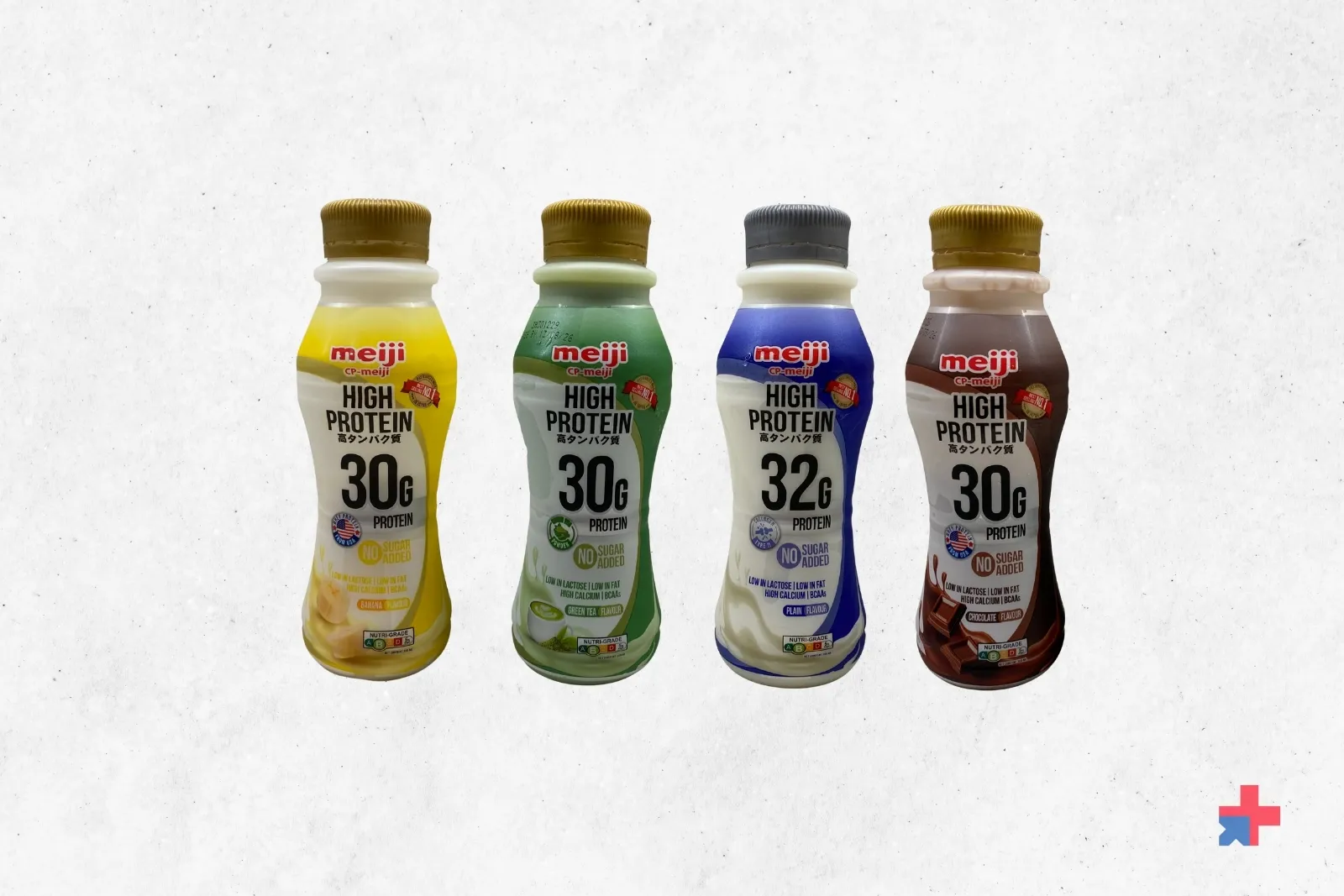
- 32g protein in the Plain 350ml bottle — 30g in Chocolate, Banana and Green Tea. Zero added sugar across all flavours.
- Low lactose, not lactose free — it’s still a dairy milk drink. Meiji sells a separate lactose-free milk if you need that instead.
- Made from real milk plus added protein, not reconstituted powder — tastes closer to flavoured milk than a supplement shake.
- Taste varies a lot by flavour — Green Tea was the surprise favourite, Original was blander than plain milk.
- Everywhere in Singapore — FairPrice, Cold Storage, Sheng Siong, Cheers, from roughly $2–$3 a bottle.
Bottom line: if you already drink flavoured milk, this is a straightforward upgrade. Dr Titus Leong’s view is that you don’t need it if you’re not training or doing manual work — normal meals cover most people’s protein needs.
1. What is Meiji High Protein Milk?
Meiji High Protein Milk is a ready to drink style protein drink made by Meiji. It is made by adding protein concentrates to a milk base. It has become popular in Singapore because of it’s price point and it’s found conveniently at supermarkets.
2. Meiji High Protein Milk Nutritional Facts
Nutrition Facts · Per 350ml bottle
Meiji High Protein Milk — all four flavours
| Nutrient |
Original
|
Chocolate
|
Green Tea
|
Banana
|
|---|---|---|---|---|
| Protein | 32.2 g | 30.1 g | 30.1 g | 31.2 g |
| Energy | 180 kcal | 179 kcal | 165 kcal | 176 kcal |
| Fat, total | 1.8 g | 2.1 g | 1.4 g | 2.1 g |
| Saturated fat | 1.4 g | 1.4 g | 0.9–1.0 g | ~1.4 g |
| Trans fat | 0 g | 0 g | 0 g | 0 g |
| Carbohydrate | 8.8 g | 9.8 g | 8.1 g | 8.1 g |
| Total sugar | 5.3 g | 4.6 g | 4–5 g | 4–5 g |
| Added sugar | 0 g | 0 g | 0 g | 0 g |
| Dietary fibre | 0 g | 1.4 g | LOW | LOW |
| Sodium | 228 mg | 228 mg | 200–230 mg | 200–230 mg |
| Calcium | 700 mg | ~725 mg | HIGH | HIGH |
One bottle of Meiji High Protein Milk gets you most of the way through a day’s protein target on its own.
Dr Titus Leong put the actual numbers to us: “The Dietitians Australia website states that adult men require 0.84g of protein per body weight kg daily, or 0.75g/kg/day for women. Interestingly, the requirements are greater for elderly individuals, at 1g/kg/day, in order to prevent the muscle wasting that tends to occur in the elderly population.”
For a 60kg woman, that’s around 45g a day. So a 350ml bottle plus a normal day of meals gets you there comfortably.
3. Meiji High Protein Milk Flavours & Taste
Meiji High Protein Milk comes in 4 flavours: Original, Chocolate, Green Tea and Banana. The original version comes with Type II collagen aiming to help joint support.
I have tried all of them and here is my verdict:
The most surprising flavour that stood out to me was the Green Tea flavour. I actually don’t think there are (or any) green tea flavoured protein drinks in the market so I was really unsure what to expect. The green tea taste was not overpowering and it was actually really smooth tasting.
The Banana and Chocolate flavours are similar to Banana or Chocolate Milk. Really similar to other protein drink brands as well. The Chocolate flavour however was a bit too sweet for my liking.
The one that I personally didn’t like taste wise was the original flavour. Somehow it tasted even more bland than normal milk and I didn’t think that was possible.
They are in general not very sweet tasting so it holds true to it’s claim of not having any added sugars.
4. Is Meiji High Protein Milk Lactose-Free?
Meiji High Protein Milk is not lactose-free but it is marketed as low in lactose. It is still a dairy milk drink made with milk protein concentrate and whey, so some natural milk sugars remain.
“Low in lactose” is not the same claim as lactose-free, and it’s worth being precise about the difference. We asked Dr Titus Leong what a lactose-intolerant person should actually make of a “low lactose” label.
His view was that the safer assumption is still the strict one: “It would make sense that lactose-free protein shakes are a good option for people with lactose intolerance. If people with lactose intolerance are unable to have lactose-free protein shakes, they might want to see their GP, as they may have an alternative diagnosis — such as IBS or IBD — instead of lactose intolerance.”
In other words, “low lactose” is a reasonable bet if your intolerance is mild, but it isn’t a guarantee, and reacting to a genuinely low-lactose product like this one is a signal worth following up on rather than shrugging off.
If you are lactose intolerant, consider other protein shake alternatives that are lactose free like Fairlife Protein Shakes.
5. Potential Benefits & Who it’s for
Meiji High Protein Milk is for someone who needs protein easily, as 30g of protein per bottle is quite a lot.
It’s also great generally great for muscle recovery after training, and who don’t want the trouble of making their own protein drinks. If you are looking for something similar but powder version, check out Muscle Nation’s Daily shake.
6. Meiji vs Rokeby Farms vs Applied Nutrition vs Fairlife
Head To Head
Meiji vs Rokeby Farms vs Applied Nutrition vs Fairlife
Compare |
Meiji High Protein Milk · Original |
Rokeby Farms Protein Smoothie · Strawberry |
Applied Nutrition High Protein Shake · 500ml |
Fairlife Nutrition Plan · 340ml |
|---|---|---|---|---|
| Protein | 32.2 gper 350ml · 9.2g per 100ml | 30 gper 425ml · 7.1g per 100ml | 42 gper 500ml · 8.4g per 100ml | 30 gper 340ml · 8.8g per 100ml |
| Calories | 180 kcal | 287 kcal | 240 kcal | ~150 kcal |
| How it’s made | Milk base + added protein concentratereal milk, not reconstituted | Cold-filtered fresh milkno added powder | Reconstituted milk protein concentratedried powder + water | Ultra-filtered milk + lactaseprotein from the milk itself |
| Added sugar | 0 g | Yes — cane sugarsome flavours | 0 g | 0 g |
| Total sugar | 5.3 gnaturally occurring | 25.1 gincludes added cane sugar | 17 gnaturally occurring | 3–6 gmost lactose removed |
| Fat | 1.8 g | 6.4 g4.7g saturated | 0.5 g | 2–3 g |
| Lactose | Low lactosenot lactose free | Low lactose~2.1g per bottle; lactase added | Not lactose free | Lactose freeremoved by ultra-filtration |
| Sweetener | Noneno artificial sweetener | Cane sugarno artificial sweetener | Sucralosevery sweet | Sucralose + acesulfame-K |
| Calcium | 700 mg88% of daily intake | 833 mg104% of daily intake | Not stated | ~730–750 mg~60% DV; Nutrition Plan 340ml |
| Taste | Light flavoured milkclosest to regular milk | Creamy, real flavoured milk | Thick, powdery, very sweet | Rich and creamy, milkshake-like |
| Buy in Singapore | EverywhereFairPrice, Cold Storage, Sheng Siong, Cheers | In storesFairPrice, Cold Storage | In storesFairPrice, Shopee, Amazon.sg | Online onlyAmazon, Lazada, Ubuy |
| Best for | Lowest sugar & calories | Taste closest to milk | Most protein per dollar | Lactose intolerance |
So far we have tested Fairlife Protein Shakes, Rokeby Farms Protein Smoothie and Applied Nutrition High Protein Shake.
Fairlife and Rokeby Protein drinks are similar as they do not have added protein powders. Instead they use a filtration process to concentrate the milk. So the protein content comes from the milk itself.
Fairlife Protein Shakes however are the only one of the four that are lactose free. So if you are lactose intolerant this is the one for you.
Applied Nutrition and Meiji Protein drinks are similar as they add protein concentrate to milk itself. However in my taste test, I felt that Applied Nutrition Protein shake tasted a lot sweeter despite not having any added sugar.
7. Where to buy in Singapore (2026)
Meiji High Protein Milk can be found at most supermarkets in Singapore such as NTUC FairPrice (and NTUC online), Sheng Siong, Cold Storage and convenience stores.
8. Do you actually need a protein shake?
Dr Titus Leong’s answer here doesn’t change by product: “I would say you probably don’t need to incorporate protein shakes into your diet if you’re not actively trying to build muscle in the gym or doing manual labour for a job. Ensuring that you have sufficient protein in each meal should suffice for the average Singaporean.”
There’s a reasonable case that Meiji sits in a slightly different category to the other three shakes we’ve reviewed, though. It’s still milk with more protein and less sugar than most of what’s sitting next to it in the chiller.
If you already drink flavoured milk, swapping it for this isn’t really “adding a supplement” the way a powder-based shake is; it’s closer to picking a better version of a drink you were having anyway.
If you’re not actively training and aren’t drinking flavoured milk already, though, Dr Titus’s advice is to focus on getting enough protein spread across your actual meals.
If you are training seriously and want a specific number rather than a general guideline, his advice from earlier stands too: speak to a dietitian.
PROTEIN SHAKE
Frequently Asked Questions
Is Meiji High Protein Milk lactose-free?
No. It’s marketed as low in lactose, not lactose-free, and it’s still a dairy product made with milk protein concentrate and whey.
If you need a genuinely lactose-free option, Fairlife is the ready-to-drink choice, or Meiji’s own dedicated lactose-free milk line.
How much protein is in one bottle?
32g in the Plain/Original 350ml bottle, and 30g in the Chocolate, Banana and Green Tea flavours.
Does it really have zero added sugar?
Yes, across all four flavours.
What sugar is present comes naturally from the milk itself, not from anything added during production.
Which flavour tastes the best?
Our tester’s pick was the Green Tea — smooth and not overpowering, unusual for the category.
Original was the least popular, tasting blander than regular milk. Chocolate and Banana were closer to standard flavoured milk, though Chocolate ran a bit too sweet.
Is it a meal replacement?
No. It’s a protein top-up, not a meal.
It doesn’t carry the fibre or the broader micronutrient spread of an actual meal.
Where can I buy it in Singapore?
NTUC FairPrice (in-store and online), Cold Storage, Sheng Siong, and Cheers convenience stores.
It’s one of the most widely available protein drinks in Singapore.
How does it compare to Rokeby Farms, Applied Nutrition and Fairlife?
Meiji and Applied Nutrition both add protein concentrate to a milk base; Rokeby Farms and Fairlife instead filter real milk to concentrate the protein already in it.
Fairlife is the only one of the four that’s genuinely lactose-free. Full comparison above.
Do I actually need a protein shake?
Probably not, unless you’re training seriously or doing physically demanding work.
Dr Titus Leong’s view is that most Singaporeans get enough protein from their normal meals. Since Meiji is essentially fortified milk, though, swapping your regular flavoured milk for it is a reasonable upgrade even if you’re not specifically supplementing.
Is it suitable for vegetarians?
Yes — it’s a dairy product with no meat-derived ingredients.
Worth confirming on-pack, since flavoured variants sometimes use colourings that aren’t vegetarian-friendly — you flagged the same issue with Rokeby’s carmine.
Is it halal certified?
Yes. Meiji High Protein Milk sold in Singapore is Halal certified.
Medically Reviewed
About the Expert
 Reviewer
Dr Titus Leong
BClinSc/MD — Physician, Flinders University Graduate
Dr Titus Leong is a doctor currently working in Australia with multiple years of clinical experience across both rural and metropolitan settings. A graduate of Flinders University, he works at a tertiary hospital servicing roughly 50,000 inpatients annually and is part of their Basic Physician Training programme.
Written By
About the Writer
 Writer
Timothy Leong
Writer, Content Editor & Marketing Specialist — MMC
Timothy Leong is the writer, content editor, and marketing specialist at MMC. With experience in writing and creating websites for local businesses, he makes sure that everything online runs smoothly.