This article shares personal experiences and is for informational purposes only. It is not career or medical advice.
TL;DR – Paths to Medical School in Singapore
- A-Levels & IB remain the main route — top grades (90-pointers / ~45 IB) get you to interviews.
- Polytechnic graduates increasingly enter with strong GPAs — subject doesn’t matter as much as excellence.
- Duke-NUS postgraduate entry welcomes career-changers with any bachelor’s degree, bringing extra maturity.
- Overseas twinning & foundational programmes offer global alternatives for Singaporeans.
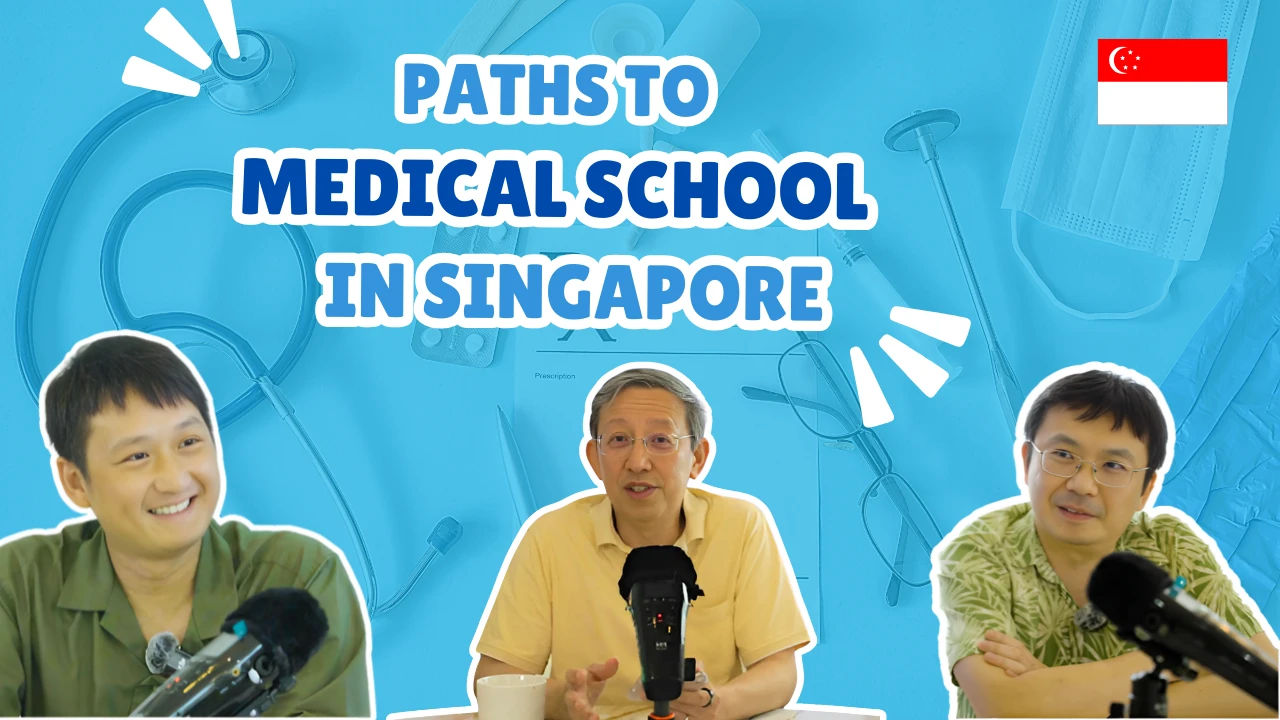
In the opening episode of Uncle Talks Podcast, three Singapore doctors—Dr Kenneth Tan, a private GP and NUS assessor; Dr John Hsiang, a gastroenterologist with international training; and Dr Leong Choon Kit, a veteran family physician who has taught across all three local medical schools—turned their conversation to a question that preoccupies thousands of young Singaporeans each year: how does one actually get into medical school here?
What emerged was a lively, insider’s map of the routes available, drawn from decades of assessing applicants, mentoring pre-med students, and reflecting on their own journeys. Their discussion reveals a system that, while fiercely competitive, offers multiple doors—from the classic A-Level path to polytechnic surprises and postgraduate second chances—each carrying its own demands and advantages.
The landscape they describe is one of high stakes and high standards. Thousands apply annually to the undergraduate programmes at NUS and NTU, and nearly all who reach the interview stage boast near-perfect grades.
Yet the doctors emphasised that academic excellence alone is rarely enough. As Dr Kenneth Tan explained, drawing from his experience assessing at NUS, the process begins with screening portfolios before moving to in-person assessments that include solo tasks, group exercises, and interviews designed to reveal character and motivation.
The Traditional Route: A-Levels and IB Dominance
For most Singaporeans, the journey still starts in junior college. The A-Level route remains the dominant pathway, with high scorers—often 90-pointers—filling the bulk of places. Dr Leong Choon Kit recalled how he and his peers entered through this system decades ago, a route that remains intensely competitive today.
Dr Kenneth Tan noted that IB students follow a comparable track, with scores around 45 points considered equivalent to top A-Level results. Both qualifications demand strong performance in sciences, particularly chemistry and biology or physics, reflecting the foundational knowledge medical schools expect.
What makes this route challenging is the sheer volume of outstanding candidates. “Most of them are excellent,” Dr Kenneth Tan observed. “I don’t think there’s a poor candidate out of all those that we’ve met.” The real differentiation happens at the interview stage, where assessors probe for clarity of purpose, ethical reasoning, and genuine exposure to healthcare. Students who have completed attachments in clinics or hospitals, taken on leadership roles, or volunteered meaningfully stand out because they can speak from experience rather than theory.
The doctors acknowledged that this path suits high-achieving school-leavers who thrive in a structured, exam-driven environment. Yet they also hinted at its limitations: the youth and relative inexperience of direct entrants sometimes show in their approach to complex clinical scenarios, a point that sets the stage for alternative routes.
Polytechnic Graduates: An Increasingly Viable Pathway
One of the more surprising threads in the conversation was the growing presence of polytechnic students in medical school cohorts. Dr Kenneth Tan pointed out that a certain percentage now enter via this route, provided they achieve a strong GPA—typically at least 4.0. Strikingly, the diploma subject does not appear to matter greatly; even non-science diplomas can lead to admission if the academic record is exceptional.
This pathway highlights Singapore’s recognition that talent and maturity can come from diverse backgrounds. Polytechnic graduates often bring practical, hands-on perspectives that complement the more theoretical preparation of A-Level or IB students. The doctors noted that these entrants demonstrate commitment through their choice of route, having pursued a diploma before pivoting to medicine—a decision that requires both academic excellence and determination.
For students who may not have secured top A-Level or IB results but possess strong polytechnic performance, this route offers a genuine second chance. It also reflects a broader trend in Singaporean education: valuing applied learning alongside academic rigour. The presence of polytechnic graduates in medical school cohorts serves as quiet proof that the system, while demanding, is not rigidly elitist.
Postgraduate Entry: Duke-NUS and the Value of Maturity
The conversation took an intriguing turn when the doctors discussed Duke-NUS Medical School, Singapore’s graduate-entry programme modeled on the American system. Unlike the five-year undergraduate MBBS at NUS and NTU, Duke-NUS offers a four-year MD for those who already hold a bachelor’s degree in any field.
Dr Leong Choon Kit and Dr Kenneth Tan both highlighted the maturity these students bring. “They are adult learners,” Dr Leong Choon Kit said. “They’re more serious in their work, a lot more committed.” Dr Kenneth Tan echoed this, noting that Duke-NUS students often display greater responsibility and perspective compared with direct entrants.
Dr John Hsiang added that he had encountered similar patterns in New Zealand and Australia, where postgraduate cohorts included graduates from music, arts, even theology.
This route appeals to career-changers or those who discovered their calling later. A degree in any discipline can serve as the foundation, provided the applicant meets the rigorous selection criteria.
The doctors’ observations suggest that medical schools value the life experience and logical thinking these students contribute, qualities that enrich both classroom discussions and clinical training.
The postgraduate path thus serves as a powerful reminder that medicine welcomes determined individuals at different life stages. For those who missed undergraduate entry or pursued other passions first, it represents not a consolation prize, but a deliberate, mature choice.
Overseas and Twinning Programmes: Global Options for Singaporeans
The doctors briefly touched on international routes, including twinning programmes like those offered by the International Medical University (IMU) in Malaysia and foundational courses in Australia. Students complete pre-medical studies locally or regionally before transferring to partner universities overseas, often earning a degree from the foreign institution.
These pathways appeal to students seeking alternatives to local competition or desiring international exposure. While some programmes involve bonds (particularly government-sponsored ones), others offer flexibility for self-funded students. The conversation acknowledged that such routes expand possibilities, especially for those who may not secure a local place on their first attempt.
The Core Discovery: Multiple Paths, One Shared Commitment
By the end of their discussion, the doctors had sketched a system far more varied than many assume. From the high-stakes A-Level and IB routes to polytechnic breakthroughs, postgraduate maturity at Duke-NUS, and overseas twinning options, Singapore offers several credible ways into medicine.
Yet the common thread was unmistakable: success demands not just academic brilliance, but clarity of purpose, real-world exposure, and resilience. As Dr Kenneth Tan put it, the strongest candidates “have thought through quite a number of the ethical issues [and] principles of medicine” and can demonstrate relevant experience.
For aspiring students and their families, the takeaway is empowering. The path may be arduous, but it is not singular.
Whether through traditional excellence, polytechnic grit, or postgraduate reflection, determination and genuine commitment can open doors.
In a small nation with world-class medical education, the routes are diverse enough to accommodate different strengths—and the profession is richer for it.
If you are weighing this decision, reflect on whether medicine is the right path for you by hearing from those who have already taken the step.
Want to hear more about resilience, timing, and the real-life moments that shape a medical career? Listen to the original Uncle Talks Podcast.
FAQ – Paths to Medical School in Singapore
1) What is the most common way to enter medical school in Singapore?
The traditional A-Level or IB route — most successful applicants have near-perfect grades (90-pointers or ~45 IB) and strong portfolios before interviews.
2) Can polytechnic students get into medical school in Singapore?
Yes — a growing number do, usually with at least a GPA of 4.0. The diploma subject doesn’t seem to matter as much as strong overall performance.
3) What is Duke-NUS and who can apply?
Duke-NUS is Singapore’s postgraduate medical school — a four-year MD programme open to anyone with a bachelor’s degree in any field, valuing maturity and life experience.
4) Do overseas or twinning programmes lead to medical practice in Singapore?
Yes — programmes like IMU twinning or Australian foundational courses let students complete degrees overseas. Graduates can return and practise after meeting Singapore Medical Council requirements.
5) What really helps you stand out in medical school applications?
Beyond grades, assessors look for clear purpose, ethical thinking, healthcare exposure (e.g., attachments/volunteering), leadership, and honest motivation — not just rehearsed answers.